

Exclusive insights content on every NHS system
- Easy-to-read ICS profiles and Investigations
- In-depth Briefings on the big picture trends shaping the landscape
- Benefit from over 50 data points that will help benefit your business case

Identify your best opportunities
- Create Watchlist Alerts to keep your team up to date with key partners and prospects
- See Investigations, Leadership, Documents, Spend and more for every system in one place
- Pinpoint opportunities and map your strategy with six powerful insight modules: National, Systems, Organisations, Leadership, Documents, and Spend
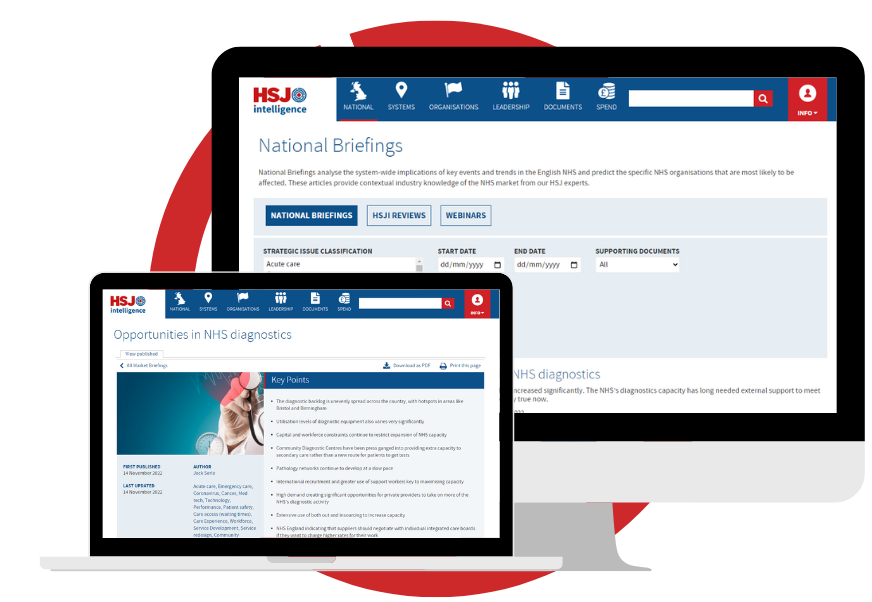
Download a sample HSJi Investigation
Using a mixture of proprietary intelligence, HSJ Intelligence brings you the top strategic issues facing specific providers and health systems.
 How the NHS is shifting the focus of its elective push
 The new NHS Genomic Medicine Service
 The NHS’s new financial rules, and what they mean for trusts and ICBs
Latest HSJi review discusses how this financial year is soon coming to an end
Read Jack Serle's latest HSJi Review, which discusses how this financial year is soon coming to an end, and it is one that the NHS will not look back on fondly. Read the full article here.
Latest Investigations
University Hospitals of Leicester Trust
A major acute trust facing significant performance and financial challenges is pursuing an ambitious strategy to become one of the largest hospital groups in England, supported by a close partnership with electronic patient record provider Nervecentre and a collaboration with Microsoft to expand the use of AI, while also progressing enabling works for a new hospital development set to begin in 2026.
Private sector contribution to increased diagnostic activity
Diagnostic waiting lists continue to grow despite record levels of activity, with the Midlands and East of England remaining the most challenged regions and increasingly stretching targets set to drive further demand; an additional nine million tests will be required by 2029, with the private sector expected to deliver around a third of this activity, supported by a forthcoming national procurement framework likely to favour established suppliers, while at least 30 new Community Diagnostic Centres – half privately run – are planned alongside expanded straight-to-test pathways, integration with the NHS App, and a growing role for AI in improving diagnostic pathways.
Cambridgeshire and Peterborough Integrated Care System & Bedfordshire, Luton and Milton Keynes ICS
Integrated care board operates with limited shared history across its three constituent parts and no executive director representation from Hertfordshire, while neighbourhood working has been devolved from the main board, creating variation in local development; despite this, five clinical priorities have been identified for targeted intervention, major services are undergoing commissioning changes, and the Hertfordshire place partnership now oversees a £300m commissioning budget, positioning the system at the forefront of innovation with a ground-breaking shift of care out of hospitals.
Data Points
The following data points were updated this week:
- Name for Wales, Scotland in February
- Leadership for ICS, Wales, Scotland in February
- Oversight level for Scotland in Q3 2025-26
- Emergency care streaming indicator, Type 1 Departments - Major A&E %, Emergency care streaming indicator, Type 3 Departments - Other A&E/Minor Injury Unit, Four hours A&E performance (all patients), 12 hour A&E waits, 12 hour A&E waits (% of total attendances), A&E attendances, Discharge delays due to ‘internal’ reasons, Discharge delays due to ‘external’ reasons, % beds occupied by delayed discharges and Super stranded patients for Acute in February
- Discharge delays due to ‘internal’ reasons and Discharge delays due to ‘external’ reasons for ICS in February
- E-COLI HOSPITAL-ONSET CASES (12-MONTH ENGLAND AVERAGE), E-COLI HOSPITAL-ONSET CASES (12-MONTH REGIONAL AVERAGE), E-COLI HOSPITAL-ONSET CASES (12-MONTH ROLLING COUNT), MRSA hospital-onset cases (12-month rolling count) and C-Diff hospital-onset cases (12-month rolling count) for Acute in December
- NHS talking therapies for MH in Q4 2025-26
- Year-plus waiters for ICS in Q4 2025-26
- Number of cases waiting over one year and Proportion of cases waiting over one year % for Acute, community, and specialist in January
- Elective patients waiting more than 18 weeks for Acute, Sp in Q4 2025-26
Latest Profile Updates
East of England Community Health and Care NHS Trust
North Cheshire and Mersey NHS Foundation Trust
Royal Free London NHS Foundation Trust
Kingston and Richmond NHS Foundation Trust
North London NHS Foundation Trust
Hampshire and Isle of Wight Healthcare NHS Foundation Trust
View all ProfilesWhat our clients say
Trusted by









Find out more about how HSJ Intelligence can help you
Complete the form below and a member of the team will contact you.
HSJI Experts
With unrivalled access to senior figures, NHS data sources and rigorous primary research, HSJ experts have a unique insight on the NHS, and deep understanding of the strategic issues facing NHS organisations and leadership teams. HSJi offers exclusive, predictive analysis explaining key trends and the specific NHS organisations that are likely to be affected.

Alastair McLellan
Editor

Ben Clover
Bureau chief

Annabelle Collins
Senior correspondent

Matt Discombe
Correspondent

Oliver Hudson
Analyst

Nick Kituno
Correspondent

James Illman
Bureau chief

Alison Moore
Correspondent

Jack Serle
Senior insights correspondent

Dave West
Deputy editor